How to Choose a Sunscreen That Doesn't Leave a White Cast
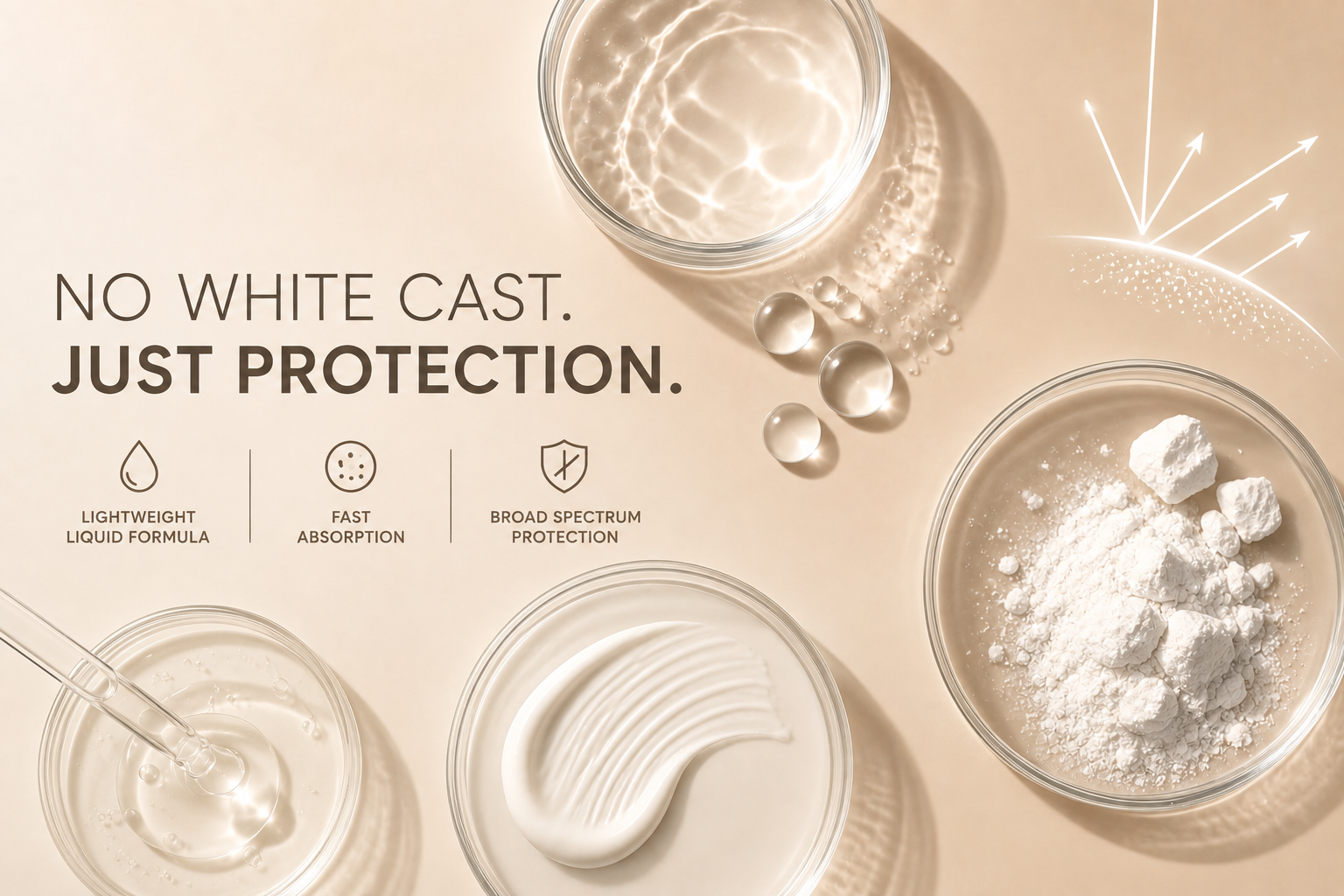
If you've ever put on sunscreen and looked in the mirror to see a ghostly, grey-ish tint staring back, you already know why white cast is one of the most common reasons people skip sunscreen altogether. The irony is that skipping it does far more damage than any white cast ever could. The real fix isn't avoiding sunscreen — it's choosing the right formula.
What Actually Causes White Cast?
White cast usually comes down to three things:
The type of UV filter — Mineral filters like zinc oxide and titanium dioxide physically sit on the skin's surface to reflect UV rays. In larger, uneven particles, they scatter visible light too, which shows up as a whitish or greyish tint.
The texture of the formula — Thick, cream-based sunscreens are harder to spread thin, so the filters end up sitting in a visible layer instead of blending into the skin.
How much (and how) you apply it — Applying sunscreen in thick dabs instead of spreading it evenly makes any cast far more obvious, especially on deeper skin tones.
Why Liquid Sunscreen Helps Avoid White Cast
Liquid, fluid-based sunscreens are formulated differently from traditional creams:
Finer filter dispersion — The UV filters are milled more finely and distributed more evenly through a lightweight, water-like base, so they don't clump or sit as a visible film.
Thinner application layer — Because the texture is fluid, it naturally spreads thinner across the skin, which means less product sitting on the surface.
Faster absorption — Liquid formulas sink in quickly, leaving a more natural, skin-like finish instead of a chalky top layer.
Easier reapplication — Since it's light and quick-absorbing, you're more likely to actually reapply through the day, which matters more for real-world protection than any single application.
Try: Bodilicious Hydrating Sunscreen Spray SPF 50++++ — a lightweight, liquid mist-style formula designed to blend in quickly with no visible residue, ideal for reapplication over makeup or bare skin through the day.
How to Choose the Right Formula for Your Skin Tone
Medium to deep skin tones: Prioritize liquid or fluid sunscreens over thick cream or stick formats. These are far less likely to oxidize into a grey or ashy tint and blend more seamlessly into deeper tones.
Oily or acne-prone skin: A liquid sunscreen with a matte or gel-like finish helps avoid both white cast and a greasy sheen — look for oil-free, non-comedogenic formulas.
Sensitive or reactive skin: If mineral filters tend to leave a cast on your skin, look for a well-formulated liquid sunscreen where the zinc or titanium dioxide is finely milled, rather than switching to a heavier cream that may cast even more.
Try: Bodilicious Liquid Sunscreen — formulated for a smoother, more blendable finish that minimizes the chalky look often associated with mineral sunscreens.
The Right Way to Apply Sunscreen (So It Doesn't Cast)
Even the best formula can look patchy if applied incorrectly. Here's how to get an even, invisible finish:
Use enough product. Under-applying doesn't reduce cast — it just reduces protection. Use roughly a fingertip's worth for the face.
Dot, then press — don't drag. Dot small amounts across the face and press it into the skin with your fingertips instead of rubbing it in one direction, which can push pigment into streaks.
Let it settle for a minute before makeup. Give the formula a few seconds to sink in fully before layering anything on top.
Reapply with a light hand. For touch-ups, a liquid or spray formula is far easier to layer without building up a visible layer than a thick cream.
A Simple No-Cast Sunscreen Routine
Morning:
Cleanse and moisturize as usual
Apply liquid sunscreen evenly, pressing it into skin
Wait 1–2 minutes before makeup or SPF-layered products
Through the day:
Reapply every 3–4 hours using a lightweight spray or liquid formula
Blot excess oil first if needed, then reapply — don't skip reapplication to avoid cast, since under-protection is the bigger risk
FAQs
Q: Does chemical sunscreen never cause white cast? Chemical filters are generally less likely to cause white cast than mineral ones since they absorb into the skin rather than sitting on top, but texture still matters — a thick chemical sunscreen can still feel heavy or look shiny.
Q: Is mineral sunscreen bad for dark skin tones? Not inherently — it depends on the formulation. Finely milled mineral filters in a liquid or fluid base blend far better on deeper skin tones than older, thicker mineral formulas.
Q: Can I fix white cast after applying sunscreen? Gently pressing in any remaining residue with a damp fingertip or beauty sponge can help blend it out, but choosing a liquid formula from the start avoids the problem entirely.