What Is Hyaluronic Acid, and Why Does Every Serum Have It?
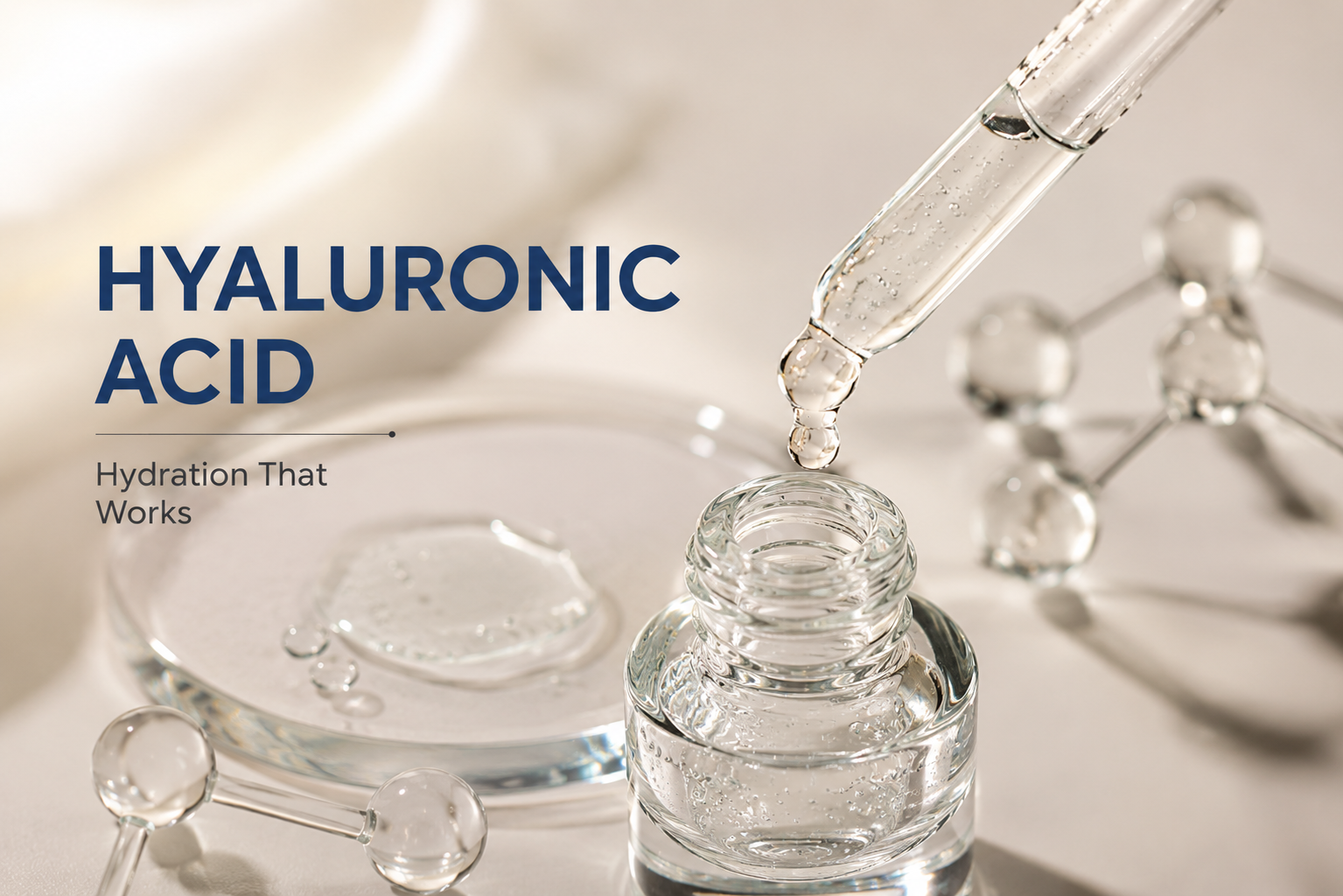
If you've ever checked the ingredient list on a handful of different serums — a brightening one, an anti-aging one, an acne one — there's a good chance hyaluronic acid showed up on all of them. That's not a coincidence, and it's not just a marketing trend either.
What Is Hyaluronic Acid?
Hyaluronic acid is a substance your body already produces naturally — it's found in skin, joints, and connective tissue, where its job is to retain moisture and cushion. In skincare, it's extracted or synthesized in a lab and added to products specifically for its exceptional ability to attract and hold water: up to 1,000 times its own weight, depending on the molecular form used.
It's not an exfoliating acid like glycolic or salicylic acid, despite the name — it doesn't remove dead skin cells or resurface skin. Its entire job is hydration.
Why Does Every Serum Seem to Have It?
A few reasons hyaluronic acid shows up almost everywhere:
It's a humectant, not an active with a narrow target. Unlike an ingredient formulated specifically for pigmentation or acne, hydration is something nearly all skin benefits from, regardless of skin type or main concern.
It layers well with almost anything. Because it's lightweight and doesn't interact negatively with most other actives, brands can add it to a vitamin C serum, a retinol serum, or an acne treatment without disrupting what that product is actually trying to do.
It works on all skin types, including oily skin. Despite being a hydrating ingredient, it's not oil-based, so it doesn't add greasiness or clog pores the way a heavier moisturizer might.
It genuinely helps almost every other active work better. Well-hydrated skin generally tolerates active ingredients (retinol, acids, vitamin C) better than dehydrated skin does, so including it alongside stronger actives can reduce irritation.
How Hyaluronic Acid Actually Works
As a humectant, hyaluronic acid pulls water toward itself — ideally from the air around you, or from a layer of moisture already on your skin. This is why the application method matters more with hyaluronic acid than with most other ingredients: applied correctly, it draws in extra hydration. Applied incorrectly (to completely dry skin, in a very dry climate, with nothing to seal it in), it can occasionally pull moisture from the deeper layers of your own skin instead, leaving skin feeling more dehydrated rather than less.
How to Use Hyaluronic Acid Properly
Step 1: Apply to damp, not bone-dry, skin Right after cleansing, while skin still has some moisture on it, is the ideal time to apply.
Step 2: Always follow with a moisturizer This is the step people skip most often, and it's the one that matters most. Moisturizer seals in what the hyaluronic acid just drew in — skipping it defeats much of the point.
Try: Bodilicious Hyaluronic Serum — formulated with Hyaluronic Acid, Glycerin, Panthenol, and Squalane for daily AM and PM hydration, suitable for all skin types including oily and combination skin.
Step 3: Use it both morning and night Since it's not an exfoliating or resurfacing active, there's no need to limit frequency the way you would with retinol or AHA/BHA — twice-daily use is standard.
Common Mistakes to Avoid
Skipping moisturizer afterward — the single most common mistake, and it undoes much of the benefit
Applying it to completely dry skin — reduces its effectiveness at drawing in moisture
Assuming it's the same as an exfoliating acid — it isn't, and won't help with texture or resurfacing the way glycolic or salicylic acid would
FAQs
Q: Can I use hyaluronic acid every day? Yes, it's gentle enough for twice-daily use, morning and night, unlike stronger actives that need to be introduced gradually.
Q: Does hyaluronic acid work for oily skin? Yes, it's lightweight and non-greasy, making it suitable for oily and combination skin alongside dry skin.
Q: Why does my skin feel more dry after using hyaluronic acid? This usually happens when it's applied to very dry skin without a moisturizer on top, or in a low-humidity environment. Always follow with a moisturizer to lock in hydration.
Q: Can I use hyaluronic acid with other actives like retinol or vitamin C? Yes, it layers well with almost all other active ingredients and can help skin tolerate stronger actives better.